

Technical partners CEA, Matek, Roofit, and Evowall are conducting cutting-edge tests on solar façade components
The EU-funded REN+HOMES project is driving innovation of solar façade technologies. The project partners CEA, Matek, Roofit, and Evowall are conducting cutting-edge tests on Building Integrated Photovoltaic (BIPV) façade components. The aim is to improve the energy efficiency of buildings by optimising the design and performance of solar façades. The testing is taking place at the CEA-INES facilities across two platforms: the Solar Test Bench (STB) and the Façade Components Test (FACT) tool.
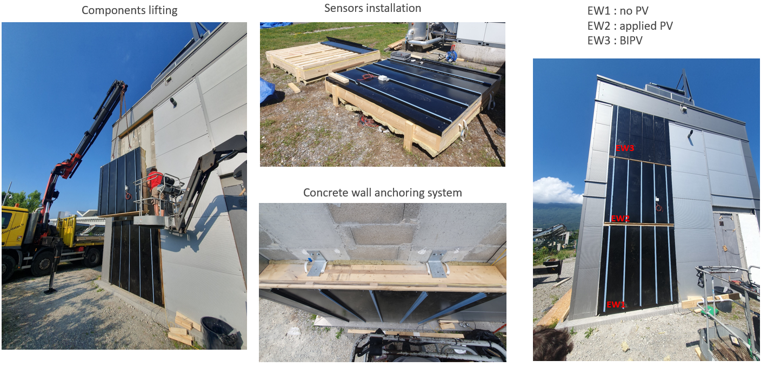
Photo credits: CEA/Roofit/Matek
Solar Test Bench (STB) Trials
At the STB, researchers are investigating the impact of varying airgap thicknesses between photovoltaic panels and insulation layers on thermal transfer and solar energy production. The controlled tests simulate real-world conditions using artificial sunlight, with irradiation levels ranging from 500W to 1000W and wind speeds up to 3 m/s. The BIPV prototype, designed and built by the project team, features adjustable airgaps of 25mm, 75mm, and 100mm. Data will determine how these parameters affect both thermal and PV performance.
FACT Tool Trials for Prefabricated Façades
Simultaneously, another set of trials is underway using the FACT tool to assess and compare prefabricated façade components. Three types of façades are being studied. One with integrated BIPV, one with applied Photovoltaic (PV) panels, and a third without any PV integration. These components have been installed on the east-facing façade of the FACT facility, where they are being monitored for thermal and PV performance in real-world conditions. The project team designed and built the façades in collaboration with Matek and Roofit, and installed them along with the sensor systems over the summer.
Evowall Façade Testing
In addition to the BIPV and PV trials, the REN+HOMES project includes testing of prefabricated façade components developed by Evowall. These façades use different insulation materials—Expanded Polystyrene (EPS) and airbag insulation—with both ventilated and non-ventilated designs. The objective is to compare their thermal behaviour under various environmental conditions. This offers insights into the efficiency of different façade designs. Sensors were installed during the manufacturing process, with the final installation and monitoring systems completed in July.
Next Steps
Data analysis is currently ongoing for all trials. Early results are expected to provide crucial insights into optimising energy performance in future buildings. By examining the impact of airgap thickness in BIPV designs and the thermal behaviour of prefabricated façades, REN+HOMES is at the forefront of developing more sustainable construction practices across Europe.
Stay tuned for further updates on this innovative project!